
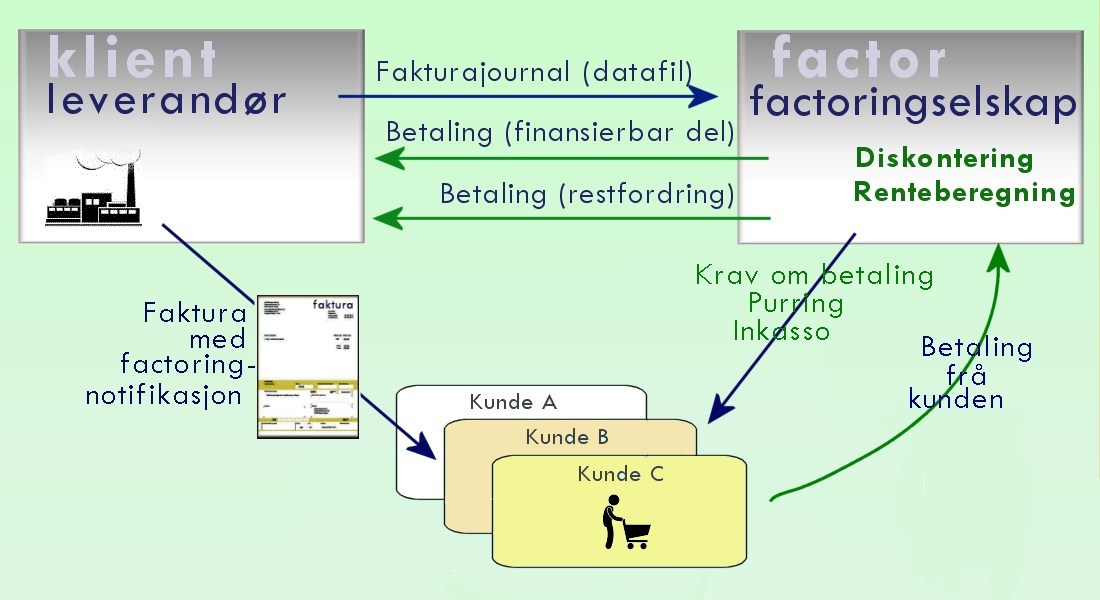
Running a limited company in the UK often means carrying a hidden liability on your own balance sheet: invoices you have already issued but not yet been paid. If you offer 60-day payment terms and have several clients all paying late, tens of thousands of pounds can sit idle while your wages, supplier bills and rent fall due on schedule. Invoice finance exists precisely to close that gap — and for many SMEs it is a more natural fit than a traditional loan.
How invoice finance works
Invoice finance is an umbrella term covering two main products: factoring and invoice discounting. Both allow you to get the value from unpaid invoices before the customer settles, but they differ in how collections are handled.
With factoring, you sell your invoices to a finance provider. The provider advances you up to 90 per cent of the invoice value, typically within 24 to 48 hours, then manages your sales ledger and chases your customers for payment on your behalf. Once the customer pays, the provider releases the remaining balance minus its fee. Because the lender contacts your customers directly, factoring is disclosed — your clients will know a third party is involved.
Invoice discounting works similarly but keeps credit control in your hands. You continue to manage your own collections; the lender simply provides a revolving credit facility secured against your ledger. This arrangement is confidential, meaning your customers deal only with you. It typically suits businesses with a well-run finance function and a turnover above around £500,000 a year.
Invoice finance does not create new debt in the conventional sense — it simply converts an asset you already hold (a receivable) into working capital. For cash-hungry growing businesses, that distinction matters.
Both types are regulated and widely available in the UK. The UK Finance asset-based lending figures consistently show billions advanced against invoices each quarter, making it one of the most commonly used forms of SME funding.

Invoice finance versus short-term business loans
Invoice finance and short-term loans are often discussed together because both can fill a cash-flow gap quickly, but they work in fundamentally different ways and suit different situations.
A short-term business loan provides a fixed lump sum repaid over a set period, usually between three and eighteen months. Lenders such as Credicorp offer unsecured facilities to UK limited companies, often with a fast decision and funds available within days. That makes a short-term loan well suited to a specific, one-off need: purchasing stock ahead of a busy season, covering an unexpected repair or bridging a gap while a contract is signed.
Invoice finance, by contrast, is a revolving facility that grows and shrinks with your sales ledger. There is no fixed repayment schedule in the traditional sense — the facility self-liquidates as your customers pay. If your cash-flow problem is structural and tied to the timing of customer payments rather than to a single expenditure, invoice finance is usually the more elegant solution.
The costs differ too. Invoice finance fees typically combine a service charge (a percentage of turnover) with a discount charge (similar to interest on the funds drawn). Short-term loan providers like Credicorp quote a representative APR, which makes it easier to compare the total cost against other credit products. You should model both options against your specific figures before committing.
A useful starting point for understanding your options is the GOV.UK business finance support finder, which lists government-backed schemes alongside commercial products.
Choosing the right option for your business
Three questions will help you decide which route to take.
What is the money for? If you need to bridge a recurring gap between invoicing and payment, invoice finance addresses the root cause. If you need a defined sum for a defined purpose, a short-term loan is simpler. Some businesses use both simultaneously — many directors with a grasp of working capital fundamentals find that a loan covers growth investment while invoice finance handles the day-to-day cycle.
How important is customer confidentiality? If you have long-standing relationships with key clients and prefer they do not know about your financing arrangements, invoice discounting — or a loan — keeps things discreet. Factoring involves your lender contacting your customers directly.
Do you have the resource to manage collections? Factoring takes credit control off your plate, which can be valuable for a small team. Invoice discounting and short-term loans both require you to stay on top of your own payments. If chasing debtors is already straining your admin capacity, factoring's managed service has real practical value.
For a broader view of how different credit facilities interact with each other, the guide to business lending explained covers the full range of SME finance options — from overdrafts and asset finance through to government-backed loans.
Whatever route you choose, the principle is the same: matching the type of finance to the nature of the need keeps costs lower and avoids putting unnecessary strain on your balance sheet. Invoice finance and short-term loans are both legitimate, well-established tools — the skill is in knowing which one fits the problem in front of you.
Frequently asked questions
What is invoice finance?
Invoice finance is a form of asset-based lending in which a lender advances you a percentage — typically 70 to 90 per cent — of the face value of your outstanding invoices. You receive the cash quickly rather than waiting for your customer to pay. Once the customer settles the invoice, the lender releases the remaining balance minus their fee.
What is the difference between factoring and invoice discounting?
With factoring, the lender takes over your sales ledger and chases payment from your customers directly, so they know you are using a finance facility. Invoice discounting is confidential — you retain control of credit control and collections, and your customers deal only with you. Discounting usually requires a more established business with strong internal processes.
Is invoice finance better than a short-term business loan?
It depends on the purpose. Invoice finance scales with your turnover and is ideal for bridging the gap between issuing an invoice and receiving payment. A short-term loan provides a fixed sum upfront and is better for a specific purchase or one-off cost. Some businesses use both: invoice finance for day-to-day cash flow and a short-term loan for a targeted investment.

Join in — free. Comments on Daily Junction are for members, so real names stay rare and bots stay out.
One field. We email you a 6-digit code — no password needed. Your comment is kept while you do it.
Under 13? You’ll need a parent’s OK first — it takes them one click.