
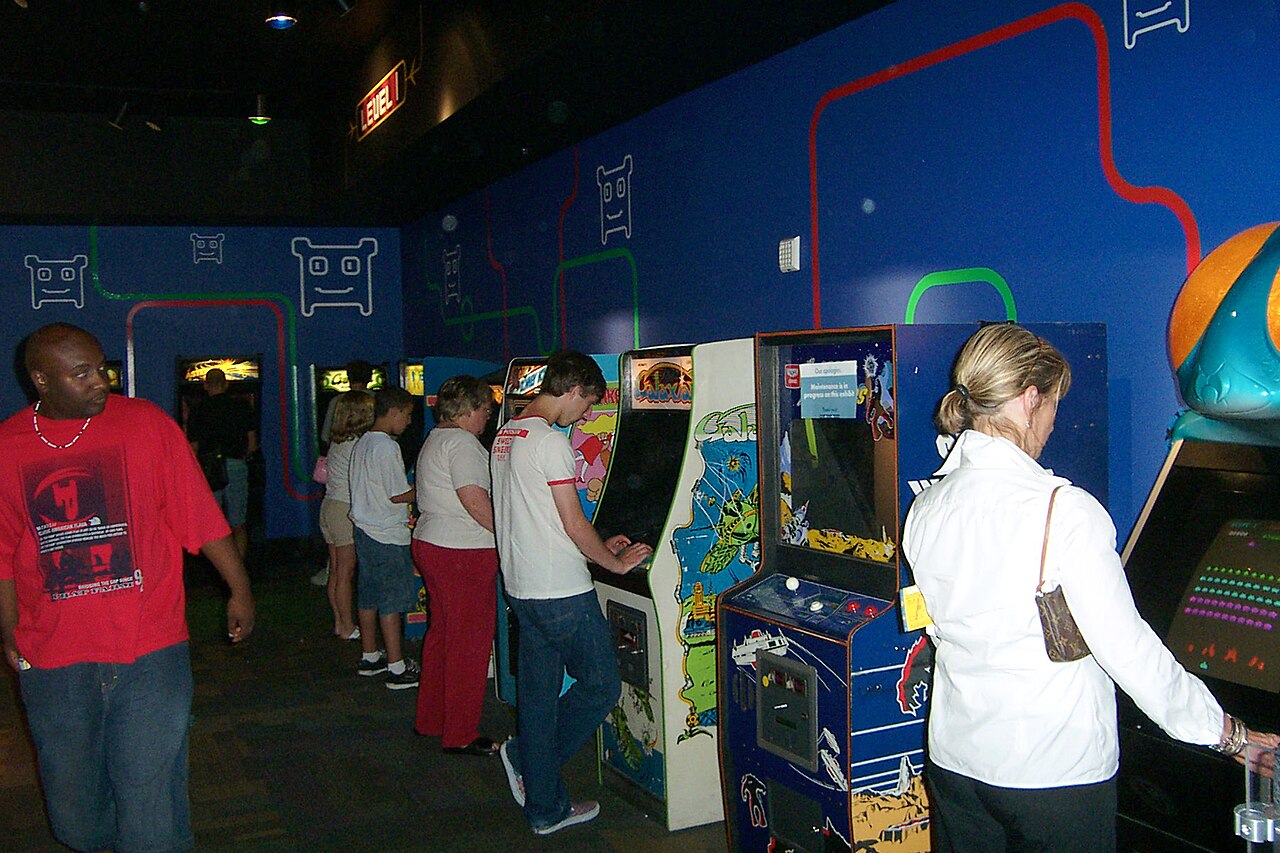
Video games began as a curiosity, a glowing novelty tucked into the corner of a bar or arcade. Within a few decades they grew into one of the largest entertainment industries on the planet, rivalling and at times surpassing film and music in scale. The story of that rise is really a story about technology reaching ever more people, in ever more places.
The arcade era: gaming as a public event
The earliest commercial video games lived in public, not at home. They were coin-operated arcade machines placed in venues where players paid for each turn. Gaming was a social, out-of-the-house activity, something you did with friends while feeding coins into a cabinet.
This era established several foundations the industry still relies on. It proved there was real money in interactive entertainment. It created the idea of the high score and competitive play. And it introduced a business model built on getting players to keep coming back for one more try, an instinct that echoes through game design to this day.
Coming home: consoles and computers
The next great leap was moving the experience into the living room. Home consoles plugged into a television and let people play without a pocketful of coins, while personal computers offered a more flexible platform that doubled as a gaming machine.
Bringing games home changed the medium profoundly:
- It turned gaming from an occasional outing into an everyday pastime.
- It made games a product families bought and owned rather than rented by the play.
- It created room for longer, deeper experiences that a coin-operated machine could never support.
Home hardware also introduced the rhythm of hardware generations. Every few years, more powerful machines arrived, each capable of richer graphics, bigger worlds and more ambitious design. With every generation, the audience widened.

Each generation widened the audience
A recurring pattern shaped the industry's growth: better technology did not just make games prettier, it made them appealing to more kinds of people.
Early games were simple by necessity. As processing power and storage grew, games gained detailed worlds, voice acting, cinematic storytelling and online play. That expansion pulled in audiences who had never been interested before, broadening gaming well beyond its original enthusiasts.
The industry's history rhymes at every stage. New hardware unlocks new kinds of experiences, those experiences attract people who were not playing before, and the audience grows again. Reach has always followed capability.
The mobile revolution
Perhaps the single biggest expansion of the audience came not from a console but from the phone. When capable smartphones became commonplace, they put a gaming device in nearly everyone's pocket.
Mobile gaming changed the picture in a few decisive ways:
- Accessibility. No special hardware purchase was needed; the device people already carried could play games.
- Casual play. Short, simple games suited spare moments, appealing to people who would never call themselves gamers.
- New business models. Many games were free to download and made money in other ways, lowering the barrier to trying them.
The result was a vast new population of players. Gaming stopped being a hobby for a defined group and became something a huge cross-section of people did, at least occasionally, often without thinking of it as gaming at all.
Digital distribution changes everything
Alongside mobile, another shift quietly transformed the business: the move from physical media to digital distribution. For most of the industry's history, a game was a physical object, a cartridge or a disc you bought in a shop. Increasingly, a game became a file you download.
This change had wide consequences:
- Instant access. Players could buy and start a game without leaving home or visiting a store.
- Large libraries. Storefronts and subscription services made enormous catalogues available at once.
- Ongoing updates. Developers could fix, patch and expand games after release, so a game became something that evolved rather than a fixed product.
- Room for small developers. Digital storefronts gave independent creators a way to reach players without the cost and gatekeeping of physical retail.
Together, mobile and digital distribution untethered gaming from dedicated hardware and physical shops, making it more flexible, more immediate and far more widely available.
A mainstream entertainment giant
The cumulative effect of these shifts is that gaming has become a mainstream pillar of entertainment rather than a niche pursuit. It now spans many platforms at once, from powerful consoles and computers to the phone in a pocket, and it reaches players across a wide range of ages and backgrounds.
That breadth is the real measure of the industry's rise. What began as a public novelty paid for by the coin is now a global form of entertainment woven into everyday life, capable of telling sprawling stories, hosting massive online communities and filling idle minutes alike.
The bottom line
The video game industry rose by repeatedly reaching more people in more places. It started in arcades as a public, pay-per-play novelty, moved into homes through consoles and computers, and then exploded outward with smartphones and digital distribution. Each step widened the audience and expanded what games could be, turning gaming from a corner-of-the-bar curiosity into one of the largest entertainment industries in the world.
Frequently asked questions
How did the video game industry start?
It began largely with coin-operated arcade machines placed in public venues, where people paid per play. Early home consoles and personal computers then brought gaming into living rooms, turning a public novelty into a household pastime.
Why did mobile gaming become so big?
Smartphones put a capable gaming device in almost everyone's pocket and made games easy to download. Many were free to start, which lowered the barrier to entry and drew in huge numbers of casual players who had never used a console.
What is digital distribution in gaming?
Digital distribution means buying and downloading games over the internet rather than purchasing a physical disc or cartridge. It lets players access large libraries instantly and allows developers to update games and add content after release.
How big is the video game industry?
Gaming has grown into one of the largest sectors of the entertainment world, reaching audiences across consoles, computers and mobile devices around the globe. Its broad appeal now spans a wide range of ages and backgrounds.



Join in — free. Comments on Daily Junction are for members, so real names stay rare and bots stay out.
One field. We email you a 6-digit code — no password needed. Your comment is kept while you do it.
Under 13? You’ll need a parent’s OK first — it takes them one click.