
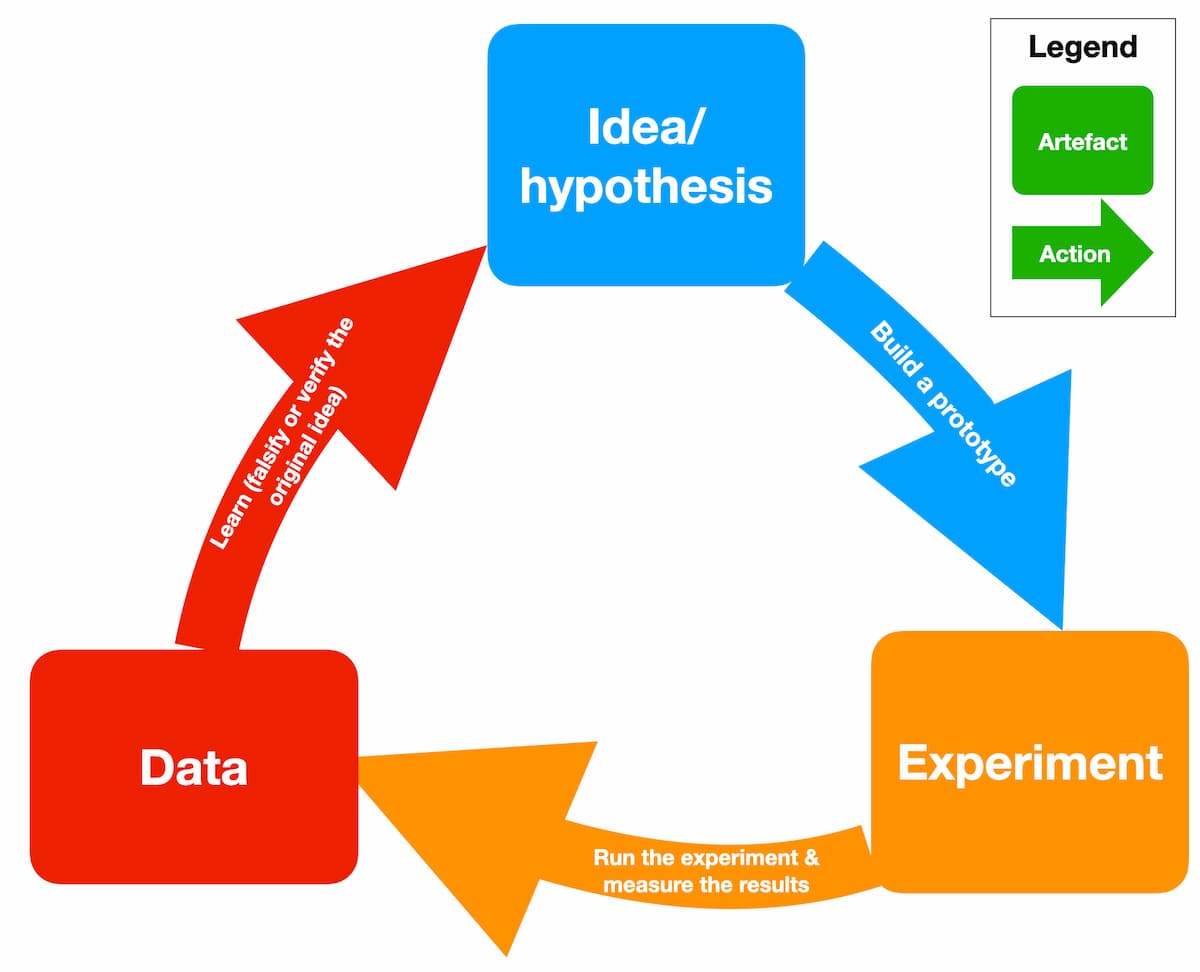
The traditional way to start a business is to write a detailed plan, build the product in secret, launch with fanfare and hope customers turn up. The trouble is that this approach bets everything on a set of guesses being right, and finds out whether they were only after the money is spent. The Lean Startup method turns that on its head. Instead of perfecting a plan, you test your riskiest assumptions as quickly and cheaply as possible with real customers, and let the evidence shape what you build next. This guide explains the core ideas, the famous build-measure-learn loop, and when the method actually helps.
What the Lean Startup is
The Lean Startup is a method for building businesses and products under extreme uncertainty by treating each idea as a hypothesis to be tested with real customers, rather than a plan to be executed on faith. It was popularised by entrepreneur Eric Ries and draws on lean manufacturing and customer-development thinking.
The central insight is simple but powerful: when you start something new, most of what you believe is a guess. Who the customer is, what they want, what they will pay, how to reach them — all assumptions. The biggest risk is not building the product badly; it is building something nobody wants. So the method's goal is to reduce the time and money spent before you discover whether your assumptions are true.
It does this by replacing "build the whole thing and launch" with a series of small, fast experiments. Each one is designed to answer a specific question with evidence. The business is steered by what you learn, not by a fixed plan written before you knew anything.
The build-measure-learn loop
The engine of the Lean Startup is a cycle called build-measure-learn. It runs in this order:
- Build the smallest thing that lets you test an assumption — a feature, a prototype, a landing page, even a manual workaround.
- Measure how real customers actually respond, using meaningful data rather than vanity metrics.
- Learn from the results: was your assumption right, wrong, or in need of refinement?
Then you go round again. The aim is to get through the loop as fast as possible, because each lap converts a guess into knowledge. A startup's real productivity is not how much it builds but how much it learns per unit of time and money.
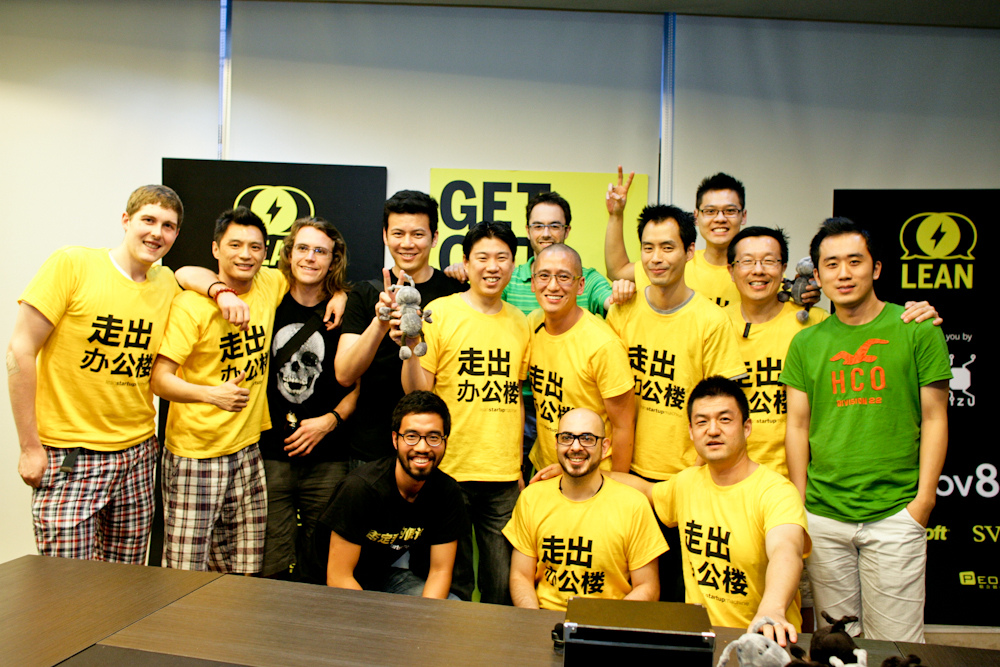
Speed through the loop matters more than the size of what you build. The faster you learn, the less you waste on the wrong thing.
Counter-intuitively, this means building less, not more. Every feature you add before testing is a bet placed without evidence. The discipline is to ask, for anything you are about to build: what will this teach us, and is there a cheaper way to learn the same thing?
The minimum viable product
The most borrowed — and most misunderstood — idea in the method is the minimum viable product, or MVP.
An MVP is the simplest version of your idea that still lets you learn something real from customers. It is minimum because it strips away everything not needed for the experiment, and viable because it is just enough to produce genuine evidence. The point is learning, not launching a polished product.
The common mistake is to treat an MVP as a shoddy first version — a half-built product shipped to save effort. That misses the purpose. A good MVP targets your single riskiest assumption. If your biggest unknown is whether anyone wants the thing at all, your MVP might be a landing page measuring sign-ups before you build anything. If the risk is whether you can deliver, your MVP might be a manual service done by hand behind the scenes. The form follows the question.
Done well, an MVP saves you from spending months building features for a product the market never wanted.
Validated learning and pivots
The Lean Startup reframes progress. In a normal company, progress means shipping features and hitting milestones. In a startup full of unknowns, that can be an illusion — you can build busily towards something nobody wants. So the method measures progress as validated learning: evidence that you have genuinely discovered something true about your customers and business.
Each trip through the build-measure-learn loop should produce validated learning. You started with an assumption, you tested it, and now you know more than you did. Over time, this accumulates into real understanding of your market.
When the evidence consistently says your current approach is not working, the method has a name for changing course: a pivot. A pivot is a deliberate, structured change in strategy — switching target customer, core feature or business model — while keeping the underlying vision. Crucially, a pivot is not a failure or a panic. It is the rational response to validated learning, and many successful companies pivoted several times before finding what worked. The alternative — pressing on with a strategy the evidence has disproved — is the real failure.
When Lean helps, and when it does not
The Lean Startup is a tool, not a religion, and it suits some situations far better than others.
It is at its best amid genuine uncertainty — a new product, an untested market, an idea where you honestly do not yet know what customers want. There, cheap experiments and fast learning are exactly what you need, and they save you from expensive guesses. This is why the method spread beyond software into services, physical products and innovation teams inside large organisations.
It is less suited to problems that are already well understood, or where getting it right first time matters more than learning fast. You would not want a bridge, an aircraft component or a payroll system built by shipping a rough MVP and iterating in front of users. Where safety, regulation or reliability dominate, careful upfront design beats rapid experimentation. The skill is judging how much real uncertainty you face and applying the method in proportion.
It also pairs well with sound business fundamentals rather than replacing them. Validated learning tells you what to build; you still need a clear business model to make it pay, an understanding of how to price your product, and the operational discipline to grow once you have found something that works. Lean reduces the risk of building the wrong thing; it does not remove the work of building a real business around the right one. National bodies such as Innovate UK and the British Library's Business and IP Centre offer support to founders putting these ideas into practice.
The bottom line
The Lean Startup is a disciplined way to build under uncertainty: treat your ideas as hypotheses, test them quickly and cheaply with real customers through the build-measure-learn loop, and let validated learning steer your decisions. A minimum viable product is the smallest experiment that produces real evidence, not a half-finished release, and a pivot is the smart response when the evidence says change course. Used where uncertainty is genuine, the method dramatically reduces the risk of building something nobody wants — its central and most valuable promise.
Frequently asked questions
What is a minimum viable product?
A minimum viable product, or MVP, is the simplest version of an idea that still lets you learn something real from customers. The aim is not to ship a cut-down product for its own sake but to test your riskiest assumption with the least effort. An MVP can be a basic feature, a landing page, or even a manual service behind the scenes — whatever gathers genuine evidence fastest.
Who created the Lean Startup method?
The approach was popularised by entrepreneur Eric Ries in his 2011 book The Lean Startup, drawing on lean manufacturing ideas and on customer-development work by Steve Blank. It has since become a widely used framework for building products and businesses under conditions of high uncertainty, used by startups and large organisations alike.
What does pivot mean in the Lean Startup?
A pivot is a structured change in strategy made in response to what you have learned — for example, changing your target customer, your core feature, or your business model while keeping the underlying vision. Pivoting is not failure; it is the deliberate result of validated learning telling you that your current approach is not working and a different one might.
Is the Lean Startup only for tech companies?
No. Although it grew up around software, the logic — test assumptions cheaply, learn from real customers, adapt — applies to any new venture facing uncertainty, including services, physical products and projects inside large organisations. It is less useful where the problem and solution are already well understood and getting it right first time matters more than learning fast.


Join in — free. Comments on Daily Junction are for members, so real names stay rare and bots stay out.
One field. We email you a 6-digit code — no password needed. Your comment is kept while you do it.
Under 13? You’ll need a parent’s OK first — it takes them one click.