

Politicians argue about it, businesses depend on it, and most people have a hazy sense that it has something to do with trade. The single market is one of the most consequential ideas in modern economics, yet it is routinely confused with a simple free-trade deal. The difference is not a technicality; it goes to the heart of how deeply countries integrate their economies. Here is what a single market is, the four freedoms it rests on, how it differs from looser arrangements, and the trade-offs it brings.
What a single market is
A single market is an arrangement in which a group of countries agree to act as a single economic territory, so that goods, services, capital and people can move across their internal borders almost as freely as they move within one country. The aim is to erase the economic significance of national borders between members, while keeping the borders themselves.
That is a bold goal, and achieving it takes more than goodwill. The central insight behind a single market is that the barriers to trade are often not the obvious ones. Tariffs, the taxes charged on goods crossing a border, are only part of the story. Just as important are non-tariff barriers: different safety standards, different labelling rules, different professional qualifications, different paperwork. A lorry held for hours at customs, or a product that must be redesigned to meet another country's rules, is a real cost even if no tariff is charged.
A single market tackles both. It removes tariffs and harmonises the rules, so that a product lawfully sold in one member can be sold in all of them without modification. That principle, often called mutual recognition backed by common standards, is what makes the whole thing work.
The four freedoms
A fully developed single market is usually defined by the four freedoms, the four kinds of movement it guarantees across internal borders.
- Free movement of goods. Products can be bought and sold across member states without tariffs, customs barriers or duplicated checks.
- Free movement of services. A business based in one member can offer its services, from banking to plumbing, in the others.
- Free movement of capital. Money and investment can flow across borders without restriction.
- Free movement of people. Citizens can live, work, study and retire in other member states.
Goods are usually the easiest to free up; services and people are the hardest, because they touch on professional regulation, public services and politically sensitive questions about migration. Many trade arrangements that call themselves single markets are stronger on goods than on the other three freedoms.
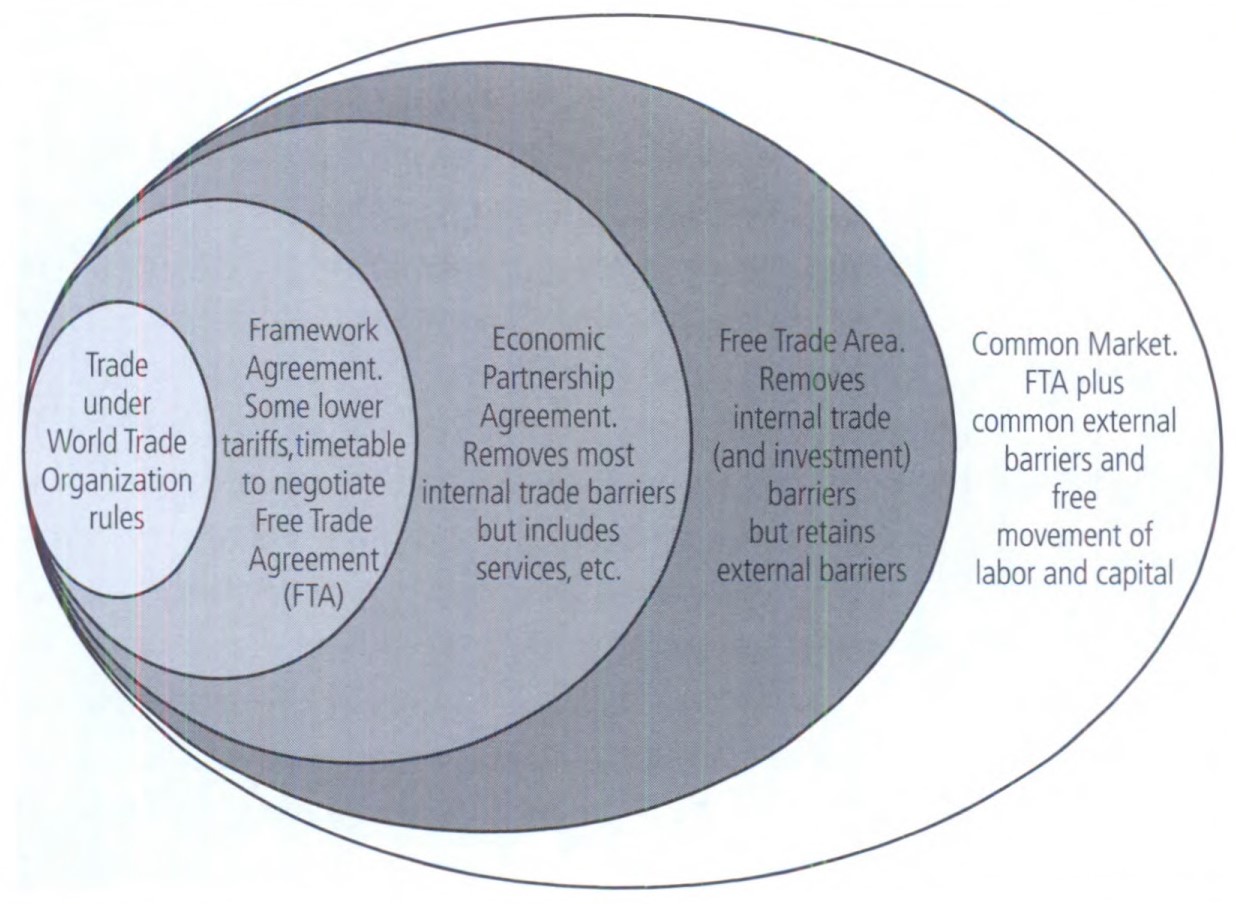
A single market is not just about removing tariffs. Its defining feature is the free movement of services, capital and people as well as goods, underpinned by common rules so that what is allowed in one country is allowed in all.
How it differs from other trade arrangements
It helps to place a single market on a ladder of economic integration, from the loosest arrangement to the deepest.
| Arrangement | What it does |
|---|---|
| Free-trade area | Removes tariffs between members |
| Customs union | Adds a common external tariff on imports from outside |
| Single market | Adds free movement of services, capital and people, plus common rules |
| Economic union | Adds shared economic and often monetary policy |
A free-trade area simply scraps tariffs between members, but each keeps its own rules and its own tariffs on the outside world. A customs union goes a step further, adding a shared external tariff. A single market is deeper still, because it removes the non-tariff barriers and frees the other factors of production. This is why joining a single market involves accepting common rules in a way a free-trade deal never requires, and why it raises questions of sovereignty that simpler deals avoid. The wider mechanics of who trades with whom, and on what terms, are covered in how international trade works.
The European single market
The most developed example by far is the European Union's single market, which treats the EU's member states, with a combined population in the hundreds of millions, as one territory built on the four freedoms. It is the EU's central economic achievement and the reason membership involves so much shared rule-making: to guarantee that a product approved in one country is accepted everywhere, members hand significant regulatory power to common institutions.
Several non-EU countries also take part in this single market through separate agreements, accepting most of its rules and freedoms in exchange for access. That arrangement shows the recurring bargain at the heart of any single market: deeper access in return for accepting common rules you have a limited hand in writing.
The benefits and the trade-offs
A single market is pursued because the gains can be large.
- More trade and lower prices. Removing barriers lets firms sell across a much bigger market and lets consumers buy from the cheapest or best supplier.
- Economies of scale. Companies can grow to serve the whole market, spreading costs and investing more.
- Choice and competition. Buyers get more options; firms face sharper competition, which can drive quality up and prices down.
- Investment. A large, barrier-free market is attractive to investors, lifting cross-border flows of the kind discussed in foreign direct investment.
But the trade-offs are real, which is why single markets are politically contested.
- Shared rules mean less national control. To keep the market frictionless, members must accept common regulations, limiting their freedom to set their own.
- Free movement of people is divisive. The freedom that lets citizens work abroad also means accepting inward migration, which can be politically charged.
- Uneven effects. The gains are not shared equally; some regions and industries gain far more than others.
These tensions are why deeper integration tends to advance slowly and why some countries prefer looser arrangements that trade a little economic gain for more control.
The bottom line
A single market treats a group of countries as one economic territory, letting goods, services, capital and people move freely across internal borders under a common set of rules. It goes well beyond a free-trade area by tackling non-tariff barriers and freeing the movement of services, money and workers, not just goods, which is why the four freedoms define it. The European single market is the leading example, delivering more trade, greater choice and larger investment, but at the price of shared rules and reduced national control. Whether that bargain is worth it is, ultimately, a political judgement as much as an economic one.
Frequently asked questions
What is a single market in simple terms?
It is an arrangement in which several countries agree to act as one territory for trade. Businesses can sell, and people can live and work, across the member countries with few barriers, because they all follow a common set of rules.
What is the difference between a single market and a free-trade area?
A free-trade area only removes tariffs, the taxes on goods crossing borders. A single market goes further by also removing non-tariff barriers, such as differing product standards, and by allowing services, capital and people to move freely, not just goods.
What are the four freedoms?
They are the free movement of goods, services, capital and people. Together they define a fully functioning single market, in which products, money and workers can cross internal borders as easily as they move within a single country.
Why do single markets require common rules?
Because the biggest barriers to trade are often not tariffs but differing national standards and regulations. By agreeing common rules, members ensure a product or service approved in one country is automatically accepted in the others, which is what makes free movement work in practice.
Join in — free. Comments on Daily Junction are for members, so real names stay rare and bots stay out.
One field. We email you a 6-digit code — no password needed. Your comment is kept while you do it.
Under 13? You’ll need a parent’s OK first — it takes them one click.