

The water you drink today is not new. The same molecules have been cycling through oceans, clouds, rivers, and living things for billions of years, used and reused without end. That endless recycling has a name, the water cycle, and understanding it explains everything from a passing rain shower to the climate of an entire continent.
What the water cycle is
The water cycle is the continuous movement of water among the oceans, the atmosphere, and the land. Scientists also call it the hydrologic cycle. As water travels, it constantly changes form, shifting between liquid water, water vapor (a gas), and ice.
Two forces keep it running. The Sun provides the energy that lifts water into the air, and gravity pulls it back down again. The cycle has no true beginning or end, but it is easiest to follow stage by stage, starting where most of Earth's water sits: the ocean.
Evaporation and transpiration
The cycle begins when water turns into vapor and rises into the atmosphere. This happens in two main ways.
- Evaporation. Heat from the Sun warms the surface of oceans, lakes, and rivers, giving water molecules enough energy to escape into the air as invisible vapor. Because oceans cover most of the planet, they are by far the largest source.
- Transpiration. Plants draw water up through their roots and release it as vapor from their leaves. Across forests and grasslands, this adds a large amount of moisture to the air. Because evaporation and transpiration happen together, scientists often combine them under one term, evapotranspiration.
A smaller contribution comes from sublimation, where snow and ice turn directly into vapor without melting first.
Condensation
As water vapor rises, it reaches cooler air higher in the atmosphere. Cool air cannot hold as much moisture, so the vapor begins to condense, turning back into tiny liquid droplets or ice crystals. These cluster around microscopic particles of dust and salt floating in the air.
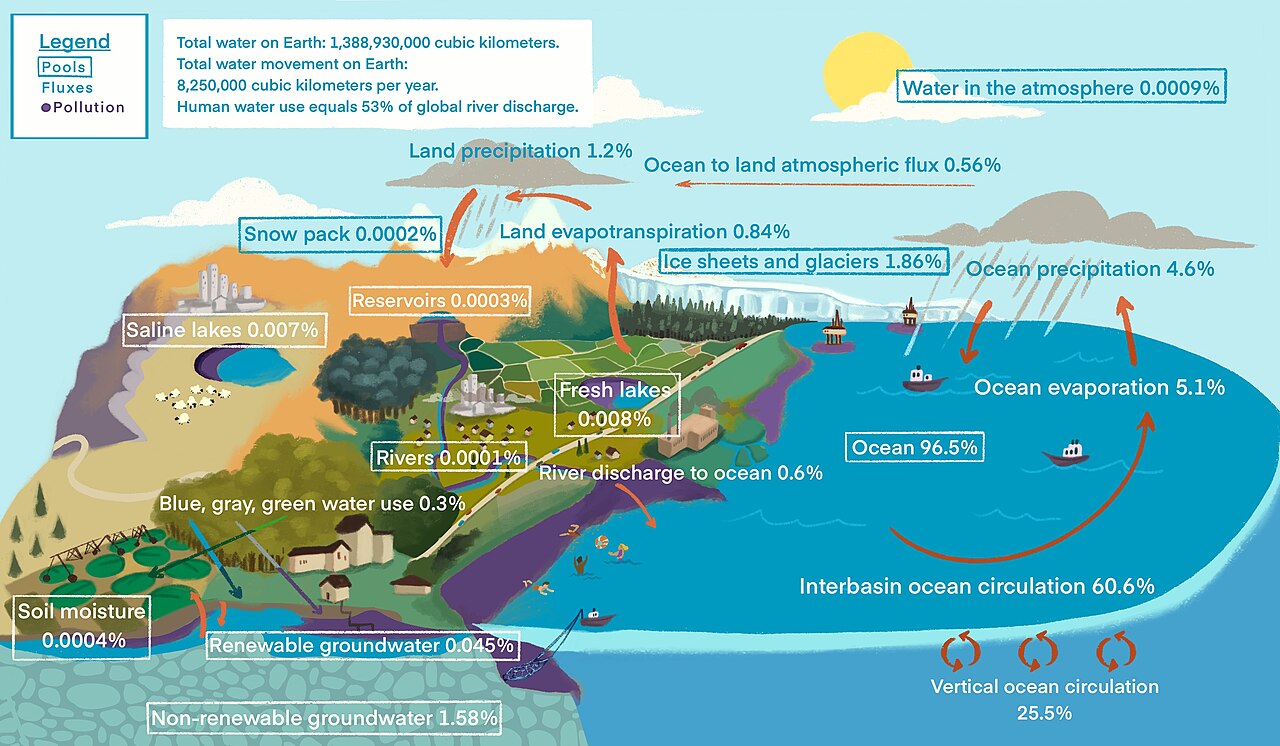
Billions of these droplets together form clouds, and lower down, the same process produces fog. Condensation is the stage that makes the otherwise invisible moisture in the air suddenly visible.
A cloud is not a container of rain waiting to fall; it is countless tiny droplets, formed where rising vapor meets cold air.
Precipitation
When cloud droplets collide and merge, they grow heavier until the air can no longer hold them up. Gravity takes over and they fall as precipitation: rain, snow, sleet, or hail, depending on the temperature along the way.
Precipitation is the moment the cycle delivers fresh water back to the surface. It is also remarkably uneven. Some regions receive heavy, regular rainfall while others remain dry for months, and these patterns are a defining feature of the world's climates.
Collection and storage
Once water reaches the ground, it gathers and is stored in several ways before the cycle begins again.
- Runoff. Water flows downhill across the land, draining into streams and rivers that ultimately return it to the ocean.
- Infiltration. Some water soaks into the soil and seeps downward to become groundwater, held in underground layers that supply wells and springs.
- Ice and snow. Large amounts are locked up in glaciers, ice caps, and seasonal snow, released slowly as they melt.
- Oceans, lakes, and rivers. These surface waters store the water until evaporation lifts it skyward once more.
From any of these stores, the water can evaporate again and repeat the journey.
Why it matters for climate and life
The water cycle is far more than a diagram in a textbook. It is one of the engines that keeps the planet livable.
- It supplies fresh water. Nearly all the fresh water that land plants, animals, and people depend on arrives through precipitation. The cycle is what turns salty ocean water into the rain and snow that fill rivers and aquifers.
- It moves heat and shapes weather. Evaporation absorbs energy and condensation releases it, transporting vast amounts of heat through the atmosphere. This drives storms, winds, and the broad patterns we experience as climate.
- It connects ecosystems. Every living thing relies on water moving through this cycle, from forests that recycle moisture to fish that depend on rivers fed by rain and snowmelt.
Because the cycle is so tightly linked to temperature, a warming climate can intensify it, increasing evaporation in some places and changing where and how heavily precipitation falls.
The bottom line
The water cycle is Earth's natural recycling system, endlessly carrying water from the oceans into the air and back to the land through evaporation, transpiration, condensation, precipitation, and collection. Powered by the Sun and pulled by gravity, it delivers the fresh water that life depends on and helps regulate the planet's climate. Every drop has made the trip countless times, and it always will.
Frequently asked questions
What is the water cycle?
The water cycle, also called the hydrologic cycle, is the ongoing process by which water moves between the oceans, the atmosphere, and the land. Water continually changes between liquid, vapor, and ice as it circulates.
What are the main stages of the water cycle?
The main stages are evaporation (and transpiration from plants), condensation into clouds, precipitation as rain or snow, and collection in oceans, lakes, rivers, ice, and underground stores.
What is the difference between evaporation and transpiration?
Evaporation is liquid water turning into vapor from surfaces such as oceans and lakes. Transpiration is water vapor released into the air by plants. Together they are sometimes called evapotranspiration.
Why is the water cycle important?
The cycle supplies fresh water to land, supports all living things, and moves heat and moisture around the globe. This makes it central to weather patterns, climate, agriculture, and the availability of drinking water.



Join in — free. Comments on Daily Junction are for members, so real names stay rare and bots stay out.
One field. We email you a 6-digit code — no password needed. Your comment is kept while you do it.
Under 13? You’ll need a parent’s OK first — it takes them one click.