

A black hole is a place in space where gravity pulls so hard that nothing can escape — not even light, the fastest thing in the universe. That is why it is black: no light can leave it to reach our eyes or telescopes.
What a black hole is
A black hole is a region of space where a large amount of matter is packed into an extremely small volume, creating gravity so strong that nothing crossing its boundary can get back out. Because light cannot escape, a black hole emits no light of its own and appears completely dark against the background of space.
It is not a hole in the everyday sense, and not empty. It is, if anything, the opposite of empty — a concentration of matter so dense that it warps the space and time around it.
How black holes form
There are different kinds of black hole, but the most familiar are stellar black holes, and they are born from the deaths of massive stars.
A star spends its life in a balancing act. Gravity constantly tries to crush it inward, while the energy from nuclear fusion in its core pushes outward. As long as fusion continues, the two forces stay in balance.
When a very massive star runs out of fuel, fusion stops and the outward push disappears. Gravity wins. The core collapses in on itself in a fraction of a second, often triggering a colossal explosion called a supernova. If the collapsing core is heavy enough, nothing known can stop the collapse, and the matter is crushed into a black hole.
Astronomers recognise several categories:
- Stellar black holes — formed from collapsing stars, typically a few to a few dozen times the mass of the Sun.
- Supermassive black holes — millions to billions of times the Sun's mass, sitting at the centres of most large galaxies, including our own Milky Way.
- Intermediate and primordial black holes — proposed in-between or very early-universe types that scientists are still studying.
The event horizon: the point of no return
The defining feature of a black hole is its event horizon. This is the invisible boundary surrounding the black hole beyond which escape is impossible. Cross it, and you cannot return; even light is trapped.
The event horizon is not a solid surface. It is simply the distance from the centre at which the escape velocity — the speed needed to break free of the gravity — equals the speed of light. Closer than that, you would need to travel faster than light to get out, which nothing can do.
At the very centre, our current theories predict a singularity, a point where matter is crushed to almost unimaginable density and the known laws of physics break down. Understanding what truly happens there is one of the great unsolved problems in physics.
A useful image: the event horizon is the edge of a waterfall you can never paddle back up. Outside it, you can still escape. Once you go over, the current always wins.
Common misconceptions
Black holes attract a lot of myths. A few worth correcting:
- They are not cosmic vacuum cleaners. A black hole only captures things that pass very close. From far away, its gravity is exactly the same as any other object of the same mass. If the Sun became a black hole of identical mass, Earth's orbit would not change.
- They are not bottomless pits to elsewhere. Ideas about black holes as tunnels to other places belong to speculation and fiction, not confirmed science.
- They are not truly invisible to us. While the black hole emits no light, the superheated matter swirling around it can blaze brightly, and that is what we observe.
How we know they are real
For a long time black holes were a prediction of Albert Einstein's general theory of relativity rather than something observed. Today the evidence is overwhelming, gathered indirectly through their effects:
| Method | What it reveals |
|---|---|
| Orbiting stars | Stars whipping around an invisible, massive point reveal a black hole's presence and mass |
| Accretion discs | Gas heated to millions of degrees as it spirals in glows in X-rays |
| Gravitational waves | Ripples in space-time detected when two black holes collide and merge |
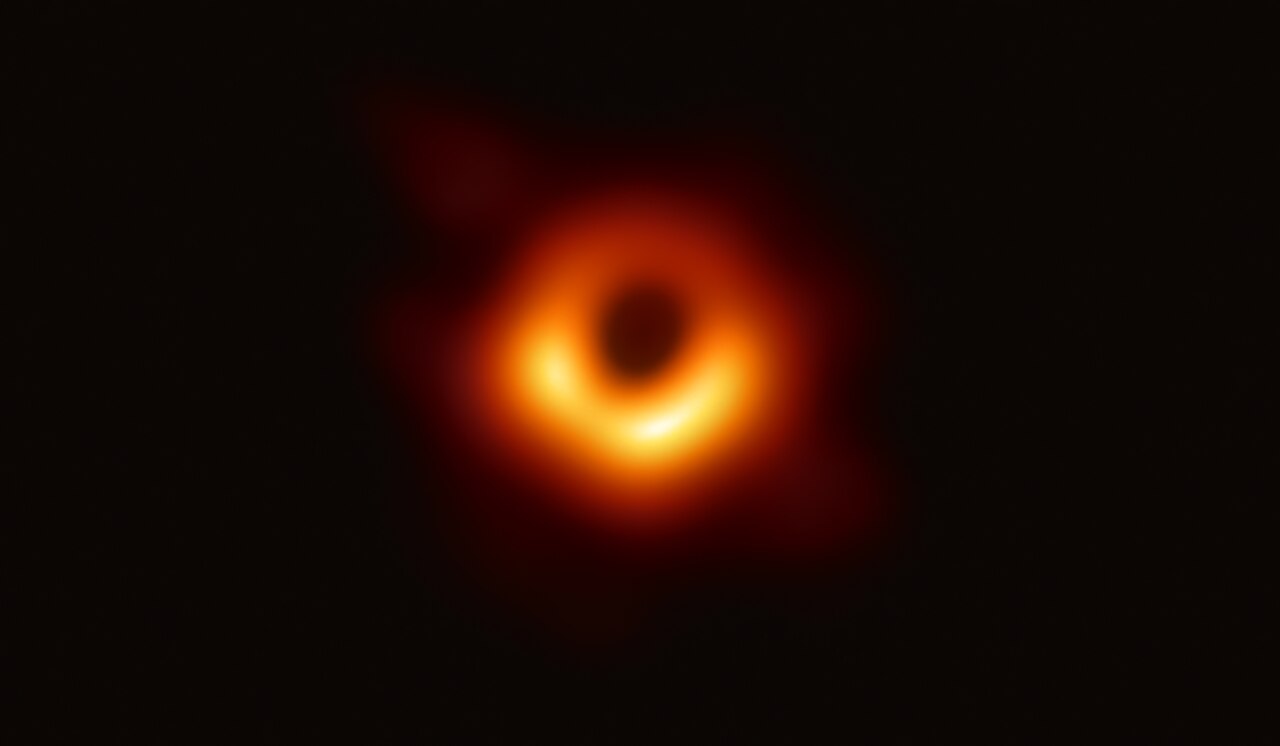
| Direct imaging | The Event Horizon Telescope captured the shadow of a supermassive black hole in 2019 |
The 2019 image of the black hole in the galaxy M87 — a dark centre ringed by glowing gas — was a landmark, showing the shadow of an object 55 million light-years away. Instruments such as the James Webb Space Telescope continue to deepen our view of these objects and the galaxies that host them.
Why black holes matter
Black holes are natural laboratories for the most extreme physics in the universe. They test our theories of gravity to the limit, help explain how galaxies form and evolve, and connect to deep questions about space, time and the fate of matter. Studying them is part of the same broad scientific effort that explains everything from what causes earthquakes here on Earth to the structure of the cosmos.
The bottom line
A black hole is a region where gravity is so strong that nothing, not even light, can escape past its event horizon. Many form when massive stars collapse at the end of their lives. They are not cosmic vacuum cleaners, and from a distance their gravity behaves like any other mass. Though we cannot see them directly, we detect them through their pull on nearby stars, the glow of in-falling gas, gravitational waves, and even a direct image of one's shadow — making black holes one of the most striking confirmations of modern physics.
Frequently asked questions
What is a black hole in simple terms?
It is a region of space where matter has been squeezed into such a tiny space that its gravity becomes overwhelming. Nothing that crosses its boundary, called the event horizon, can ever get back out, not even light, which is why it appears black.
How do black holes form?
The most common stellar black holes form when a very massive star exhausts its nuclear fuel. Without the outward pressure from fusion, the core collapses under gravity. If it is heavy enough, nothing can halt the collapse and a black hole is born, often in a supernova explosion.
Would a black hole suck in the Earth?
No. A black hole only pulls in objects that come very close to it. From a distance, its gravity is no stronger than that of any other object with the same mass. If the Sun were replaced by a black hole of equal mass, Earth would keep orbiting just as it does now.
Can we actually see black holes?
We cannot see the black hole itself, but we can observe its effects. In 2019 the Event Horizon Telescope released the first image of the glowing material and shadow around a supermassive black hole in galaxy M87.



Join in — free. Comments on Daily Junction are for members, so real names stay rare and bots stay out.
One field. We email you a 6-digit code — no password needed. Your comment is kept while you do it.
Under 13? You’ll need a parent’s OK first — it takes them one click.